Category: World News

  • 5 Killed as US Military Destroys Two Vessels in Pacific

    5 Killed as US Military Destroys Two Vessels in Pacific

    United States forces have killed five more individuals aboard vessels in the Pacific Ocean, raising the death toll from the Trump administration’s military campaign against alleged seaborne drug traffickers to at least 104 since September.

    The US military’s Southern Command (SOUTHCOM) announced on Friday that it carried out “lethal kinetic strikes on two vessels” in the eastern Pacific at the instruction of Secretary of Defense Pete Hegseth, resulting in the death of three people in one vessel and two in another.

    Thursday’s attack by US forces followed a strike on another vessel the previous day, which also occurred in international waters in the eastern Pacific and resulted in the death of four individuals, according to SOUTHCOM.

    While the US military categorized the nine victims of the recent attacks as “male narco-terrorists,” Washington has not provided evidence that the nearly 30 vessels destroyed since September in the Pacific and Caribbean were involved in drug trafficking.

    The Secretary of Defense, Hegseth, is getting a lot of criticism. People say he ordered a second attack on survivors who were holding on to pieces of a ship after an earlier attack. Experts say it is wrong to attack people who are already in trouble.

    Latin American leaders and legal experts have condemned the US attacks as “extrajudicial killings,” while Trump has attempted to justify the killings as necessary to combat drug trafficking into the US from Latin American drug cartels, particularly those based in Venezuela.

    Trump has also ordered a significant military deployment to Latin America and threatened to remove Venezuelan President Nicolás Maduro from power, accusing him of overseeing a drug trafficking cartel.

    Total Vanal Blocade of All Oil Tankers

    Earlier this week, Trump escalated tensions by ordering a “total” naval blockade of all oil tankers under US sanctions from entering or leaving Venezuelan ports, a move designed to restrict the country’s oil resources and cripple its economy.

    Maduro has condemned Washington’s military mobilization and accused Trump of using the fight against drug trafficking as a pretext for “regime change” in Venezuela and for seizing the country’s oil reserves.

    Brazil’s President Luiz Inácio Lula da Silva stated on Thursday that he is willing to mediate between the US and Venezuela to “avoid armed conflict.” Mexico’s President Claudia Sheinbaum also offered to act as a mediator to find “a peaceful solution so that there is no US intervention.”

    Lula, one of Latin America’s most influential leaders, expressed that Brazil is “very worried” about the escalating crisis between Washington and Caracas. He told reporters that he informed Trump that “things wouldn’t be resolved by shooting; it is better to sit down around a table to find a solution.”

    “I am at the disposal of both Venezuela and the US to contribute to a peaceful resolution on our continent,” he added.

    Lula also voiced concern about the underlying motivations behind the campaign.

    “It can’t just be about overthrowing Maduro. What are the other interests that we don’t yet know about?” he questioned, noting that he did not know whether it was related to Venezuela’s oil, critical minerals, or rare earths.

    “Nobody ever states concretely why this war is necessary,” he remarked.

    According to The Associated Press, around 15,000 US personnel are now involved in the operation, marking the largest military buildup in Latin America in generations, alongside 11 warships, including the US’s largest aircraft carrier, and a squadron of advanced US Marine Corps F-35 fighter jets, in addition to other planes and drones.

  • Naveed Akram Charged With 15 Murder Counts Over Bondi Shooting

    Naveed Akram Charged With 15 Murder Counts Over Bondi Shooting

    Naveed Akram is the only suspect left after the mass shooting at Bondi Beach in Sydney on Sunday. He faces 59 charges, including 15 counts of murder and one count of committing a terrorist act, according to New South Wales police.

    Akram, 24, was seriously injured during the incident. His father, Sajid Akram, 50, was killed in a gunfight with police. The attack killed 15 people and injured many more. It targeted Australia’s Jewish community during a celebration for the first night of Hanukkah. This shooting is the deadliest in Australia since 1996.

    In addition to the murder charges, Akram also faces 40 charges for causing severe harm with the intent to kill and one charge for displaying a symbol of a banned terrorist organization.

    Akram went to his first court hearing from his hospital bed. The court has postponed the case until April 2026. On Wednesday, Police Commissioner Mal Lanyon said they are waiting for Akram to recover from his medication before questioning him. He stated, “To be fair, we need him to understand what is happening.”

    As of Wednesday evening, 17 people are still receiving treatment in Sydney hospitals. One person is in critical condition, and four others are critically injured but stable. Police have labeled the attack as a terrorist incident. Australian Prime Minister Anthony Albanese said it seems to be motivated by ideas linked to the Islamic State group.


    Naveed Used Australian Passport to Enter the Philippines


    8On Tuesday, reports confirmed that a father and son traveled to the Philippines in November. The Philippine Immigration Bureau told the BBC that they were in the country from November 1 to November 28, visiting the southern city of Davao.

    Naveed Akram entered using an Australian passport, while his father, Sajid, used an Indian passport. Sajid Akram is from Hyderabad in southern India but had little contact with his family there, according to a police official from Telangana.

    The attack led to several deaths, including two rabbis, a Holocaust survivor, and a 10-year-old girl named Matilda. Boris and Sofia Gurman, a couple who had confronted one of the gunmen during the attack, also lost their lives. In total, 27 people went to the hospital for injuries, including two police officers. One officer, 22-year-old Jack Hibbert, lost vision in one eye and faces a long recovery, according to his family.

    Earlier that day, thousands attended the funeral for Rabbi Eli Schlanger, one of the first victims. Prime Minister Anthony Albanese did not go to the funeral. When asked about his absence on ABC NewsRadio, he said, “I would attend anything that I’m invited to. These are funerals taking place to farewell people’s loved ones.”

    The Jewish community criticized Albanese for not doing enough to fight antisemitism. In response, he told ABC NewsRadio he has appointed the country’s first antisemitism envoy, strengthened hate speech laws, and increased funding for community projects and Jewish institutions.

    At Rabbi Schlanger’s funeral, Rabbi Levi Wolff called his death an “unspeakable loss” for the community. “Eli was taken from us while doing what he loved,” he said. “He spread love and joy while caring for his people. His self-sacrifice made him one of the highest and holiest souls.” Rabbi Schlanger helped organize the Hanukkah event on Sunday.

    Funerals for the other victims will take place over the next few days, including for Matilda, the youngest victim, on Thursday.

  • US Sanctions Maduro’s Family & Ships For Moving Venezuelan Oil

    US Sanctions Maduro’s Family & Ships For Moving Venezuelan Oil

    The United States has announced new sanctions on shipping companies and ships that it says help move Venezuelan oil. This action puts more pressure on a key support system for President Nicolás Maduro’s government. This announcement came just a day after authorities seized a sanctioned tanker off the country’s coast that was likely carrying millions of dollars’ worth of oil.

    Included in the sanctions list released by the U.S. Treasury on Thursday are three nephews of Maduro’s wife, Cilia Flores, along with another businessman affiliated with Maduro. Notably, two of the sanctioned nephews had previously been convicted of drug trafficking charges in the U.S. before being released as part of a prisoner swap.

    The Treasury stated that these six vessels were engaged in “deceptive and unsafe shipping practices,” which contributed financial resources to Maduro’s government. Four of the vessels are flagged under Panama, while the other two are registered in the Cook Islands and Hong Kong.

    This action further escalates the Trump administration’s ongoing pressure campaign against Venezuela. This campaign has included deploying thousands of troops and a carrier strike group to the Caribbean, conducting strikes on suspected drug boats, and issuing repeated threats against Maduro.

    On Wednesday, armed U.S. personnel seized an oil tanker in international waters off the Venezuelan coast. This tanker was allegedly involved in an “illicit oil shipping network” that supports countries, including Venezuela and Iran, according to Attorney General Pam Bondi.

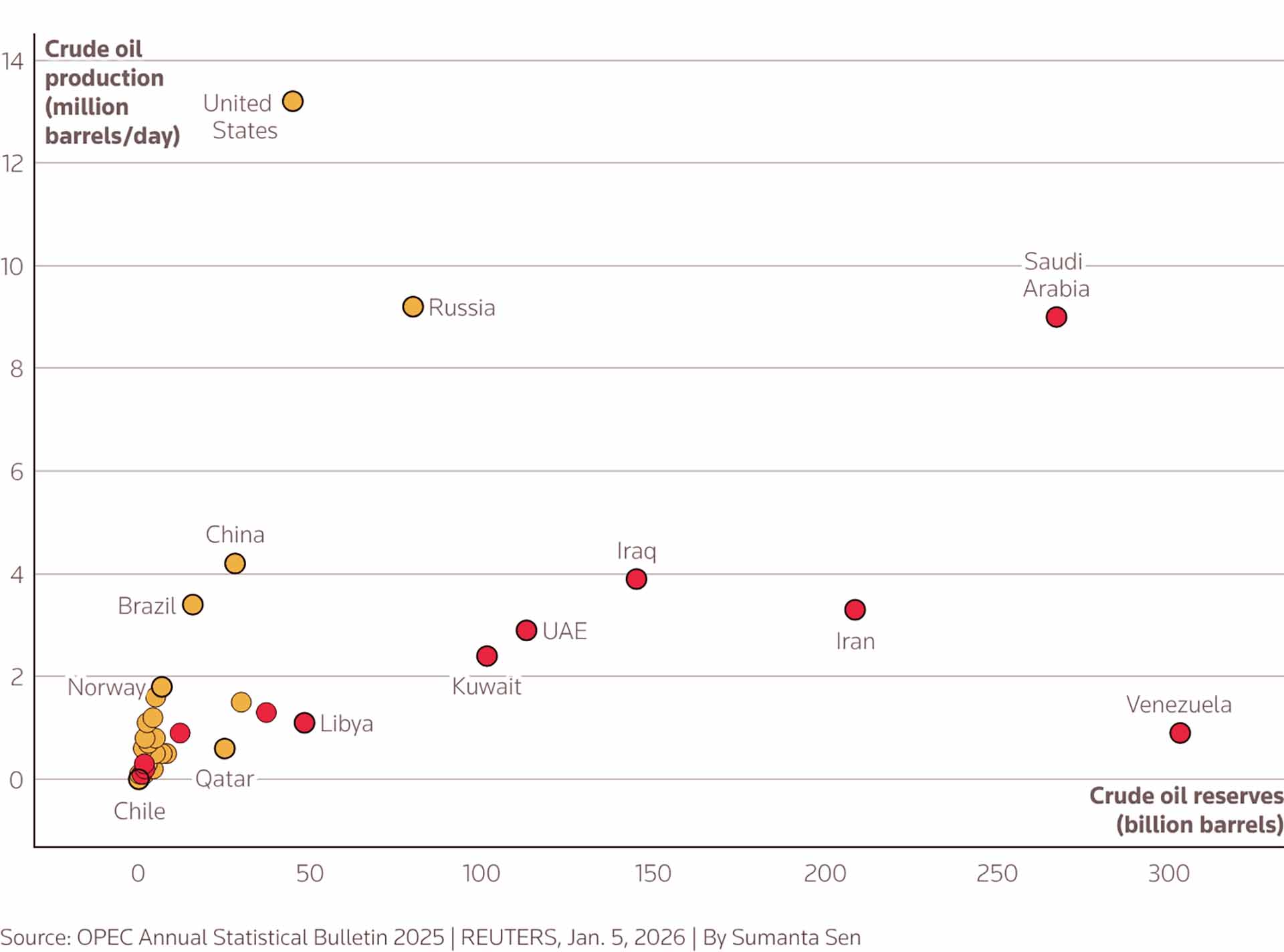
    Venezuela possesses the world’s largest known reserves of crude oil, but international sanctions and a severe economic crisis have severely impacted the country’s oil industry. Despite this, the state-owned oil and natural gas company PDVSA remains the primary source of revenue for Maduro’s cash-strapped government, largely due to a network of clandestine vessels that smuggle Venezuelan oil into global supply chains.

    Targeted Tankers Headed to Cuba

    The seized tanker was en route to Cuba and carrying Venezuelan crude when it was intercepted by U.S. forces. This occurred around the same time Venezuelan opposition leader and Nobel laureate Maria Corina Machado arrived in Oslo after defying a travel ban and fleeing the country.

    Previously named Adisa, the tanker was sanctioned by the U.S. in 2022 for facilitating oil trades on behalf of Hezbollah and Iran’s Islamic Revolutionary Guard Corps-Quds Force.

    The ship’s skipper had concealed its true location while docked at a Venezuelan oil terminal last month, according to satellite and shipping data reviewed by CNN. Although the tanker was flying a Guyana flag, it was not registered in Guyana, as confirmed by the country’s Maritime Administration Department.

    As of early Friday EST, none of the six vessels sanctioned on Thursday were located in the Caribbean, based on AIS shipping data analyzed by CNN.

    Additionally, there were at least eight tankers under U.S. sanctions related to Iran or Russia’s war in Ukraine near Venezuelan ports or off its coast, according to AIS shipping data and U.S. Treasury data. This group includes three tankers located around the Port Jose Oil Terminal, which is the same terminal where the recently seized vessel, Skipper, was spotted in satellite imagery last month.

    White House press secretary Karoline Leavitt stated that the Skipper will be taken to an American port, where U.S. authorities plan to take possession of its oil cargo.

    President Maduro said that the seizure is a sign of “new criminal naval piracy in the Caribbean.” In response, his government filed a formal complaint with the International Maritime Organization.

  • ICC Judges Resisted US Sanctions on Israeli War Crimes Cases

    ICC Judges Resisted US Sanctions on Israeli War Crimes Cases

    Judges and prosecutors at the International Criminal Court (ICC) have been cut off from banks, credit card companies, and tech giants like Amazon due to sanctions imposed by the Trump administration in the United States. These sanctions are a response to war crimes investigations involving Israeli and U.S. officials.

    The Associated Press reported on Friday that these U.S. sanctions have had a sweeping and punitive effect on nine ICC staff members, including six judges and the chief prosecutor.

    President Trump introduced new measures earlier this year through an executive order. These measures prevent certain officials from using basic financial services and from doing everyday activities like online shopping and emailing. They also stop these officials from entering the U.S., putting them under the same restrictions as Russian President Vladimir Putin. However, Putin was able to visit Alaska for a summit with Trump in August.

    “Your whole world is restricted,” said Canadian judge Kimberly Prost, one of the ICC officials targeted by the sanctions, in an interview with AP.

    The International Criminal Court (ICC), the world’s permanent war crimes tribunal with 125 member states, was targeted with sanctions in February. The White House stated that the move was in response to what it described as baseless and illegitimate actions against the United States and its close ally, Israel.

    The ICC has issued arrest warrants for Israeli Prime Minister Benjamin Netanyahu and former Defense Minister Yoav Gallant. The court accused them of committing crimes against humanity and war crimes because of their actions during the ongoing conflict in Gaza.

    Prost, who was named in the latest round of sanctions in August, expressed her frustrations in an interview with the Associated Press. She mentioned that she had lost access to her credit cards, noticed that purchased e-books had vanished from her device, and that her Amazon Alexa had stopped responding.

    “It’s the uncertainty,” Prost said. “These are small annoyances, but they accumulate.”

    She was sanctioned for her vote to allow the ICC to investigate alleged war crimes and crimes against humanity committed in Afghanistan, which included actions by U.S. soldiers and intelligence operatives.

    “I’ve dedicated my entire career to criminal justice, and now I find myself on a list alongside those implicated in terrorism and organized crime,” she stated.

    Luz del Carmen Ibanez Carranza, a sanctioned Peruvian judge, stated that the U.S. travel sanctions, which also apply to family members, prevent her daughters from attending conferences in the United States.

    These sanctions impose significant fines and potential prison time on businesses and individuals that provide “financial, material, or technological support” to those sanctioned. As a result, many are withdrawing services from the targeted individuals.

    “You’re never quite sure when your card isn’t working somewhere if it’s just a glitch or if it’s due to the sanctions,” said deputy prosecutor Nazhat Shameem Khan in an interview with the Associated Press.

    Reports of Threats Related to Warrants

    The sanctions are reportedly just one of several measures aimed at exerting pressure on the court regarding arrest warrants for Netanyahu and Gallant.

    In July, the Middle East Eye (MEE) reported that the court’s chief prosecutor, Karim Khan, was warned that both he and the International Criminal Court (ICC) would be “destroyed” if the warrants were not withdrawn.

    This threat allegedly came from Nicholas Kaufman, a British-Israeli defense lawyer at the court with ties to an adviser of Netanyahu. Khan noted that the Israeli leader’s legal adviser claimed he was “authorized” to make him a proposal that would allow the prosecutor to “climb down the tree,” according to the news website.

    In August, Khan was warned by British leader David Cameron that the UK would stop funding the International Criminal Court (ICC) if it charged two people, Netanyahu and Gallant. In May 2024, U.S. Senator Lindsey Graham also warned Khan that he could face consequences if he tried to press charges against them.

    In May, Khan’s office said he would take a break from his job while a UN investigation looked into claims of bad behavior against him. During this time, two other people helped do his work.

  • US Seized a Sanctioned Oil Tanker Off Venezuela – Trump

    US Seized a Sanctioned Oil Tanker Off Venezuela – Trump

    President Donald Trump announced on Wednesday that the U.S. has taken control of an oil tanker near Venezuela. This action has raised oil prices and increased tensions between the U.S. and Venezuela.

    “We have just seized a very large tanker, the largest ever, off the coast of Venezuela, and other things are happening,” Trump said. He has been calling for Venezuelan President Nicolas Maduro to step down.

    When asked about the oil, Trump replied, “We keep it, I guess.”

    This is the first known action against an oil tanker since Trump ordered a military buildup in the region. He has often suggested U.S. military intervention in Venezuela. Meanwhile, the U.S. has targeted vessels suspected of drug trafficking, which has raised concerns among lawmakers and legal experts.

    U.S. Attorney General Pam Bondi posted on X that the FBI, Homeland Security, and the Coast Guard, with help from the U.S. military, executed a seizure warrant for the tanker carrying oil from Venezuela and Iran that was under sanctions.

    Bondi also shared a 45-second video showing two helicopters approaching the tanker, with armed individuals in camouflage descending onto it.

    The Trump administration did not reveal the name of a seized vessel. However, a British maritime group called Vanguard reported that a tanker named Skipper was believed to have been taken near Venezuela early on Wednesday. The U.S. has placed sanctions on this tanker because of its alleged involvement in trading Iranian oil when it was known as the Adisa.

    The Skipper left Venezuela’s main oil port, Jose, between December 4 and 5 after loading about 1.1 million barrels of heavy crude oil called Merey, according to satellite data from TankerTrackers.com and information from the Venezuelan state oil company, PDVSA.

    Oil prices went up after the news of the seizure. After starting off low, Brent crude futures rose by 27 cents (0.4%) to settle at $62.21 per barrel. At the same time, U.S. West Texas Intermediate crude futures gained 21 cents (0.4%) to close at $58.46 per barrel.

    On Wednesday, President Maduro spoke at a march to honor a military battle but did not talk about the tanker’s seizure.

    Impact on Oil Prices

    Venezuela exported over 900,000 barrels of oil per day last month, making it the third-highest monthly average this year. PDVSA brought in more naphtha to mix with its extra-heavy oil output. While the U.S. has increased pressure on Maduro, it has not disrupted oil shipments.

    Venezuela has to sell its crude oil at lower prices to China because of rising competition from sanctioned oil from Russia and Iran.

    “This situation is another challenge from geopolitical issues and sanctions that affects the availability of oil,” said Rory Johnston, an analyst with Commodity Context.

    “Seizing this tanker raises immediate supply concerns, but it doesn’t change the overall situation because those barrels were already scheduled to be shipped,” Johnston added.

    Chevron, which works with PDVSA, stated that its operations in Venezuela are running smoothly. Last month, the company increased crude oil exports to the U.S. to about 150,000 barrels per day, up from 128,000 barrels per day in October.

    Rising Pressure on Maduro

    Maduro claims that the U.S. military buildup aims to overthrow him and take control of Venezuela’s oil reserves.

    Since early September, the Trump administration has carried out more than 20 strikes against suspected drug vessels in the Caribbean and Pacific, killing over 80 people.

    Experts say these strikes might be illegal because there is little public evidence showing that the boats were carrying drugs. They argue it was not necessary to blow up the boats instead of stopping them, seizing their cargo, and questioning the crews.

    Concerns grew this month after reports that the commander leading the operation ordered a second strike that resulted in the deaths of two survivors.

    A recent Reuters/Ipsos poll found that many Americans, including about one-fifth of Trump’s Republican supporters, oppose the military’s campaign of deadly strikes on these boats.

    In a strategy document released last week, Trump stated that his administration’s foreign policy would focus on reasserting U.S. power in the Western Hemisphere.

  • Trump will Engage in Sudan Peace Efforts During Ongoing Civil War – Rubio

    Trump will Engage in Sudan Peace Efforts During Ongoing Civil War – Rubio

    United States Secretary of State Marco Rubio has stated that President Donald Trump is personally overseeing efforts to end the war in Sudan, which is now in its third year and has caused severe suffering for the civilian population. During a cabinet meeting at the White House on Wednesday, Rubio emphasized that Trump is “the only leader in the world capable of resolving the Sudan crisis.”

    Last month, Trump announced plans for the U.S. to collaborate with other members of the Quad, the United Arab Emirates, Saudi Arabia, and Egypt, along with additional regional partners, to put an end to the brutal 30-month conflict.

    At a conference in the U.S., Trump said that the Saudi prince asked him for help to stop the fighting in Sudan. He called Sudan a very dangerous place and said many people there need help. Trump also said that other world leaders want him to take action to end the violence.

    The civil war in Sudan began in April 2023, when the government-controlled Sudanese Armed Forces (SAF) clashed with the paramilitary Rapid Support Forces (RSF) over control of areas, including the capital, Khartoum.

    Peace negotiations have been complicated by recent advances made by the RSF. Earlier this week, the RSF claimed to have taken control of Babnusa, a key city in the central Sudanese region of West Kordofan, although the SAF disputed this claim.

    Babnusa is a crucial gateway to the western Darfur region, which the RSF fully controlled last month, as well as to the entirety of western Sudan. The RSF’s assault on Babnusa builds on its momentum following the capture of the city of el-Fasher, the army’s last stronghold in Darfur, after an 18-month siege. The RSF has faced accusations of committing widespread atrocities in el-Fasher.


    Recent War Efforts Violate Unilateral Ceasefire


    The latest fighting appears to violate a unilateral ceasefire announced by the RSF after mediation efforts by the Quad. The Sudanese Armed Forces (SAF) turned down the ceasefire terms suggested by the Quad, saying they favor the Rapid Support Forces (RSF) too much. The SAF also accused the RSF of continuing attacks even though they declared a truce. The SAF claims that the involvement of the United Arab Emirates in the Quad is unfair and that the proposal is meant to weaken the army.

    While the UAE has been widely accused of supporting the RSF with funding and weapons, it has consistently denied any involvement.

    United Nations High Commissioner for Human Rights Volker Turk expressed his concerns on Thursday about the possibility of new atrocities occurring amidst the intense fighting between the Sudanese Armed Forces (SAF) and the Rapid Support Forces (RSF).

    The UN Human Rights Council has already initiated one inquiry into reported atrocities, which include systematic mass murder, rape, torture, and the forced displacement of non-Arab ethnic groups since the RSF took control of el-Fasher.

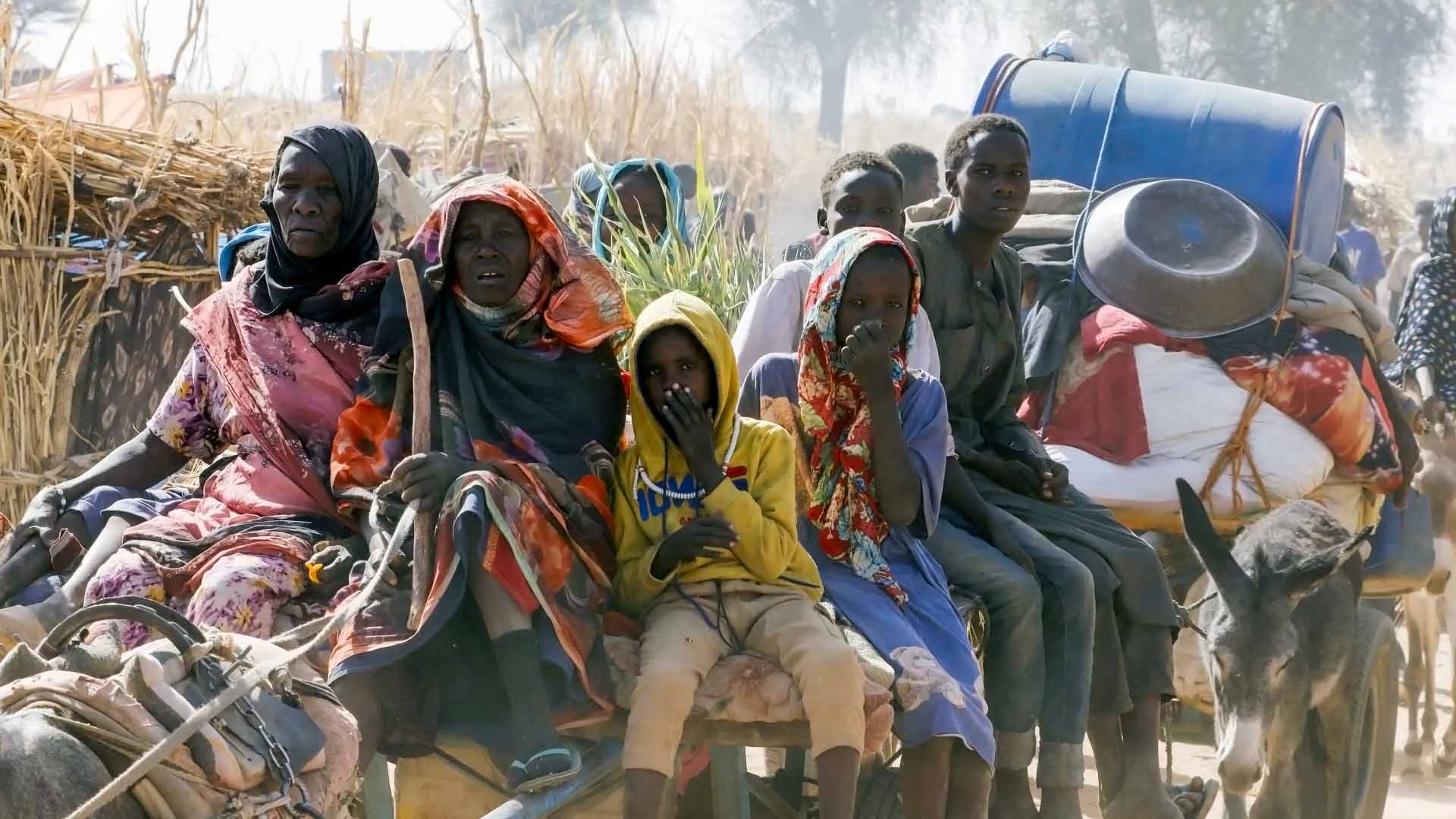
    According to UN estimates, the ongoing war in Sudan has resulted in over 40,000 deaths. The reported number of affected individuals is underestimated, with the actual figure likely much higher. The UN has called this the largest humanitarian crisis in the world, as millions have been displaced and some regions are facing famine.

  • Amnesty Urges Probe into RSF War Crimes at Sudan Refugee Camp

    Amnesty Urges Probe into RSF War Crimes at Sudan Refugee Camp

    Amnesty International has called for an investigation into war crimes following an assault by the paramilitary Rapid Support Forces (RSF) on a displaced persons camp in North Darfur, Sudan, earlier this year. The report describes serious crimes committed by the Rapid Support Forces (RSF) during a large attack on the Zamzam camp. The RSF has been accused of carrying out indiscriminate killings and mass rape in its ongoing conflict with the Sudanese military government, which started in April 2023.

    The attack on the camp, which is struggling with hunger, happened while the RSF was laying siege to El Fasher, the capital of North Darfur. The RSF now controls the state and is moving into West Kordofan, causing millions of people to be displaced.

    The attacks on the Zamzam camp – the largest facility for internally displaced persons in North Darfur – took place between April 11 and April 13. According to the report, RSF fighters deployed explosives in populated areas and randomly fired upon residential neighborhoods.

    The document provides numerous accounts of deadly attacks on civilians, with witnesses describing how RSF fighters fatally shot at least 47 people who were hiding in their homes, fleeing the violence, or seeking shelter in a mosque.

    “The RSF’s horrific and deliberate assault on desperate, hungry civilians in Zamzam camp once again highlights its alarming disregard for human life,” said Agnes Callamard, secretary-general of Amnesty International.

    “Civilians were ruthlessly attacked and killed, robbed of essential items for their survival and livelihood, and left without any means of seeking justice.”

    The assault, which included RSF fighters intentionally setting fire to homes and other buildings, as well as committing acts that may constitute rape and pillage, resulted in approximately 400,000 people fleeing the camp within just two days, according to the report.

    RSF Fighter Shouting and Shooting Anywhere

    The recent report accuses the Rapid Support Forces of serious violations during Sudan’s 30-month conflict. The report is based on interviews with 29 people, including witnesses, survivors, and family members of victims.

    The Sudanese Armed Forces (SAF), which is part of the military government, has also been accused of numerous war crimes.

    Survivors of the Zamzam attack described how RSF fighters shot at people without care and set fires, forcing residents to escape. One man said that the RSF fighters were shouting and shooting in all directions, which is how many people were killed. Another person said that you could not tell where the shelling was coming from, but it was everywhere.

    A woman, who serves as a volunteer for a nongovernmental organization, described an RSF fighter randomly firing from his vehicle while driving near the camp’s main market. According to Amnesty International, shooting without a specific military target may constitute indiscriminate attacks, which are serious violations of international humanitarian law.

    Another eyewitness shared a harrowing account of how 15 armed men stormed his compound and fatally shot his 80-year-old brother and 30-year-old nephew. “No one is concerned about our situation,” he moaned.

    No End in Sight

    Amnesty International has once again criticized the United Arab Emirates (UAE) in its report for allegedly supporting the Rapid Support Forces (RSF), a claim that has been widely made.

    The UAE has firmly denied providing arms or financial support to the RSF.

    The Sudanese Armed Forces (SAF) and the RSF have been engaged in a brutal conflict since April 2023, resulting in the deaths of tens of thousands of people and displacing nearly 12 million.

    Efforts to negotiate a truce have made little progress. Last month, the RSF declared a unilateral ceasefire following a peace plan proposed by the “Quad,” a group of mediators that includes Egypt, Saudi Arabia, the UAE, and the United States.

  • US Urged Sudan’s Warring Parties to Accept the Ceasefire Plan

    US Urged Sudan’s Warring Parties to Accept the Ceasefire Plan

    The United States envoy has urged the warring parties in Sudan to accept his truce proposal without imposing any preconditions.

    Massad Boulos, an adviser to President Donald Trump on African and Arab affairs, stated during a news conference in Abu Dhabi on Tuesday that he had presented a “comprehensive” ceasefire plan to the warring generals in Sudan, but neither side accepted it. He emphasized, “We would like them to accept the specific text that was presented to them” in its original form, referring to the commanders of the Sudanese Armed Forces and the Rapid Support Forces (RSF).

    These comments followed an announcement from RSF leader Mohamed Hamdan Dagalo, also known as Hemedti, declaring that his paramilitary group would adhere to a unilateral “humanitarian truce” for three months.

    Abdel Fattah al-Burhan, the commander of the Sudanese army, criticized the text proposed by the White House envoy, calling it “the worst” proposal since the vicious civil war began in April 2023.

    The leader of the military government said that a plan from “the Quad,” which includes Egypt, Saudi Arabia, and the United Arab Emirates, would weaken the army and keep the Rapid Support Forces (RSF) in place.

    Al-Burhan’s rejection of the plan shows his belief that the UAE supports the RSF with military and financial help, a claim the UAE denies. In March, the UAE criticized Sudan’s attempt to file a case against it in the International Court of Justice, calling the allegations a “cynical publicity stunt.”

    Anwar Gargash, the diplomatic adviser to the UAE’s president, who was with Boulos on Tuesday, stated that the UAE supports efforts to end the war and condemns the “atrocities” committed by both the army and the RSF.

    First Violation of Ceasefire

    UN urges humanitarian corridor to help civilians stuck in Sudan’s el-Fasher

    International organizations, satellite images, and eyewitness accounts have reported mass killings and rapes happening around el-Fasher for months. Amnesty International recently warned in a report that RSF (Rapid Support Forces) fighters are committing war crimes in el-Fasher.

    Amy Pope, head of the International Organization for Migration (IOM), told Al Jazeera that the main concern is getting access to people who have been cut off from humanitarian aid and services in el-Fasher. She said, “When humanitarian workers are in danger, when they are killed, shot, or detained, we cannot provide what people need to survive.”

    Pope stressed that the most urgent issue is ensuring a ceasefire and creating a humanitarian corridor so that aid groups can bring help to civilians caught in the conflict.

    Agnes Callamard, the secretary-general of the NGO, criticized the UAE for allegedly supporting the paramilitary forces. She said, “These atrocities are made possible by the United Arab Emirates’ support for the RSF. The UAE’s ongoing backing of the RSF fuels the cycle of violence against civilians in Sudan.”

    Later, the Sudan Doctors Network NGO reported that the RSF and South Sudan’s SPLM attacked the al-Zallataya Mine in South Kordofan and kidnapped more than 150 men and children. The organization called this act a “heinous crime” and pointed out that it is the first clear break of the RSF’s supposed humanitarian truce. They said that the militias took young men and children to recruit them as future fighters, which is a war crime and goes against international humanitarian law.